
Omar Afridi
Reworking the classic—how Omar Afridi designs in the space between cities, identities, and silhouettes.

During Paris Fashion Week, I reached out to a small number of brands to visit their showrooms with the goal of adding a deeper layer of insight to my upcoming articles. Because I was working throughout the week, with limited time away from our own showroom, I had to be deliberate about who I contacted.
One brand that had been on my radar for a while was Omar Afridi. I’m consistently drawn to labels that start from familiar menswear silhouettes and subtly rework them through material, proportion, or construction. In the past, I’ve written about brands like Auralee, Lemaire, and SSSTEIN for precisely this reason. As my own style is evolving, though, I’ve found myself looking for designers who take that material-first approach a step further. Omar Afridi kept resurfacing in my thoughts.
When I reached out to request a showroom visit for journalistic purposes, I was genuinely excited when they confirmed. Still, I went in with modest expectations. I assumed I’d be shown the collection, take a few photos, and perhaps hear a brief explanation of the inspiration behind it. What followed was something else entirely.
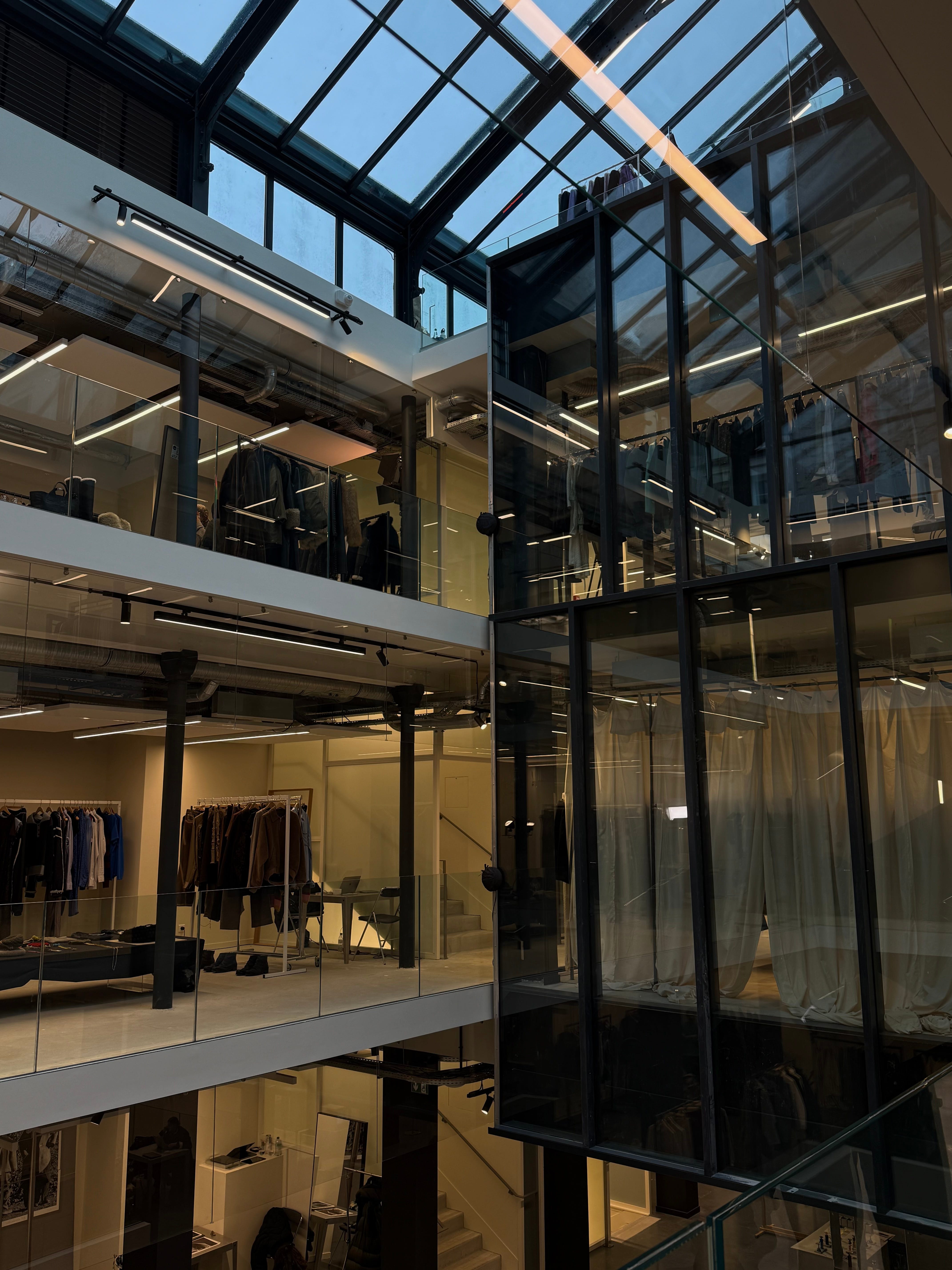
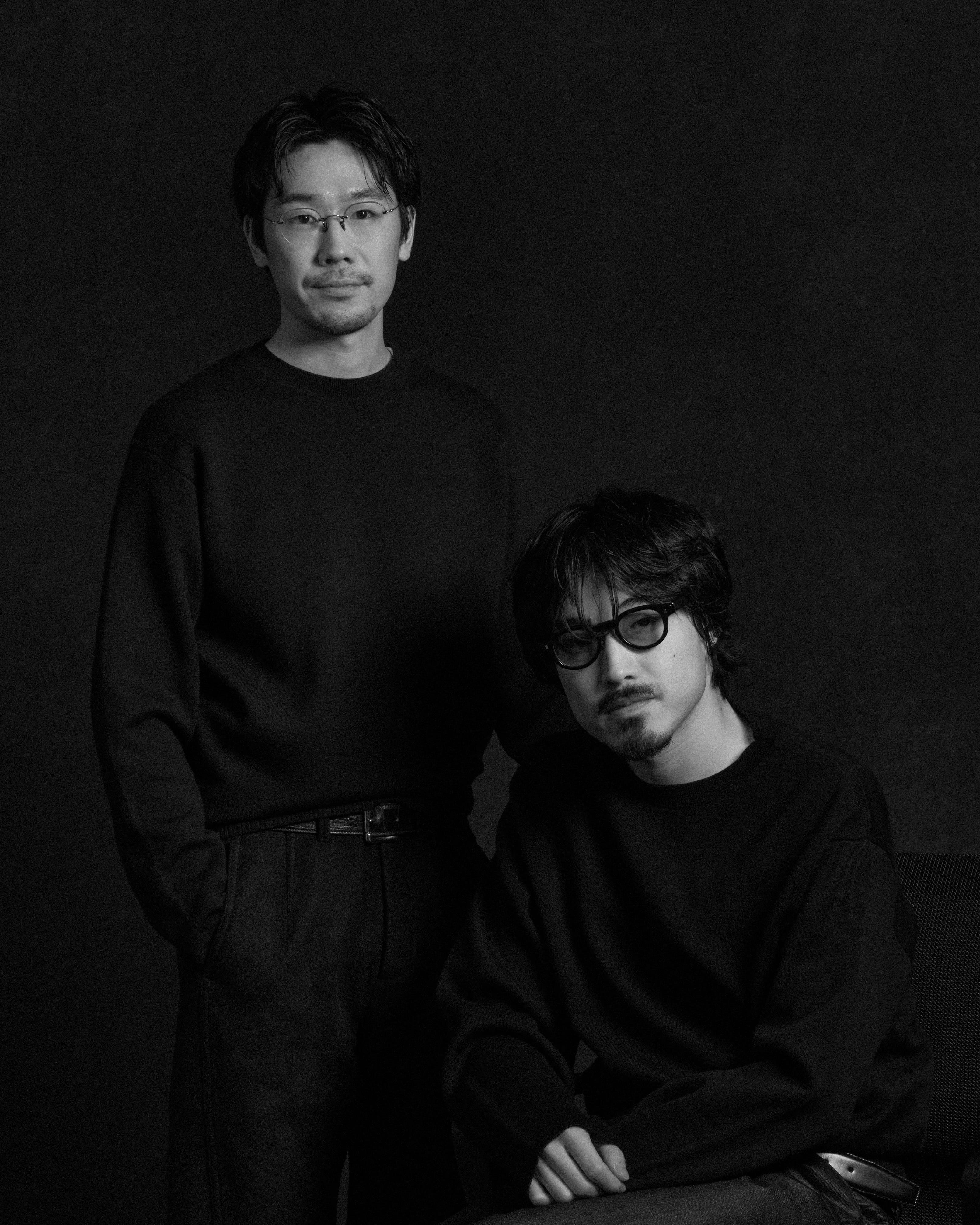
Hayate, the designer, and Alexander, who is deeply involved in the brand’s operations, took a remarkable amount of time to walk me through both the collection and the broader story of the brand. There was no sense of rushing. Just openness, curiosity, and a real willingness to engage in conversation.
I don’t say this lightly, but they were among the most thoughtful people I’ve met in fashion. It changed my relationship with the brand almost immediately. Something I already admired became far more compelling once I understood the people behind it. There’s a certain intensity to what they’re building, driven by genuine passion. If you ever find yourself in London or Tokyo, I can only recommend visiting their store. Omar Afridi is a brand worth watching, not because it demands attention, but because it earns it.
Background
Before there was Omar Afridi, there was Leon Bara—a quietly influential menswear label operating out of London in the mid-2010s. It was through that earlier project that Omar Afridi first connected with Hayate Ichimori.
At the time, Hayate was in his early twenties and living in London, where he was supposed to be studying English. One day, Hayate told me, he received an email from someone named Omar Afridi asking if they could meet. The location: a hotel bar next to Victoria Station. It was an unceremonious beginning—casual, almost accidental—but one that laid the foundations for what followed.
After working together on Leon Bara for several years, Hayate began to feel that the project had reached its natural endpoint. Back in Tokyo, he reconnected with his friend Jun Kikuta, and the two began discussing a reset—less in terms of trend or positioning, and more about intent. When later moved to London, originally with plans to pursue studies at CSM, the decision was made to formally close one chapter and open another. Leon Bara became Omar Afridi.
The name change was deliberate. Using Omar’s name felt more direct, more legible—something that could anchor a brand operating between cultures and cities. Over time, the structure clarified: London would remain the commercial and operational base, while much of the creative and conceptual gravity would continue to pull toward Japan. Layered into this is Omar Afridi’s Afghan heritage, introducing a third, quieter cultural layer—less overt in reference, but present in the brand’s sensitivity to displacement, hybridity, and in-betweenness.
Omar Afridi has never positioned itself as a loud brand. From the outset, its evolution has been gradual, almost resistant to spectacle. What it pursues instead—quietly and with precision—is a form of tension: between places, between identities, between what feels familiar and what feels just slightly off. The brand’s foundation is built on that question—and everything that follows grows from there.
The People Involved
Omar Afridi is run by a small but well-engineered team. During my visit to the showroom I had the opportunity to speak to Hayate and Alexander.
Hayate Ichimori is the designer, but the word doesn’t quite cover what he does. His training is in spatial and fashion design, and it shows—not just in the clothes, but in how he speaks about them. There’s a calm precision to his observations. No abstract moodboard language, no trend-speak. He’d point to something like the seam on a flight jacket and explain how it slightly shifts the garment’s posture on the body—not dramatically, but just enough to unsettle how we expect a classic to behave. That’s the kind of thinking that runs through the brand. Quiet alterations. Small moves with big atmospheric consequences.
Alexander, who handles brand development, was actually the first point of contact. He used to be a buyer—he discovered the brand from that side of the business, and eventually became part of it. His role today is hard to sum up neatly. Operationally, he’s the link between the brand’s internal world and the one it has to present outward. But practically, he’s a kind of translator. He was also one of the kindest people I met during the week. There was no rush, no sense of posturing—just real generosity in how he spoke about the collection and the team.
Apart from them, Omar Afridi himself remains largely in the background. The last puzzle piece is creative director Jun Kikuta. Kikuta oversees the brand’s overall visual and conceptual direction. He has been working as a stylist since his teenage years and his vision plays a pivotal role in shaping Omar Afridi’s signature aesthetic and identity.
Design Language — Primitive Mode
At the heart of Omar Afridi’s aesthetic is a term that might sound paradoxical at first: Primitive Mode. A conceptual stance—a way of thinking about clothes that resists easy categorization, yet remains unmistakably specific, operating in the space between opposites.
“Primitive,” in this context, doesn’t mean crude or unfinished. It refers to elemental forms, raw textures, and the foundational ideas that precede stylistic conventions. Mode signals fashion, refinement, and the systems that give clothing its cultural meaning. By bringing these two together, the brand enters a design conversation that questions what is essential and what is expressive in clothing.
Precisely because the definition is intentionally open, Primitive Mode becomes a lens through which the team negotiates tension: between tech and craft, between intuitive making and calculated structure, between utility and expression. The clothes themselves—whether outerwear or tailored trousers—exhibit this dialectic. Technical outerwear cuts sit alongside pieces with artisanal hand, seams and detailing that feel both intentional and improvised. There’s a quiet but persistent playfulness in how traditionally “functional” elements are repositioned—exposed seams, unexpected pocket treatments, or pressure points that reshape familiar silhouettes.
Primitive Mode is about coexistence: a reminder that garments can be structurally rigorous and experientially warm; that precision tailoring and primitive logic can be symbiotic rather than contradictory. Omar Afridi’s outerwear and pants often exemplify this: patterns that suggest a technical lineage but executed in ways that feel uncannily human rather than purely industrial.
The concept even extends into their communication system. The brand has developed a custom typeface family—four fonts derived from the logotype—which is intentionally tied to Primitive Mode: a visual articulation of tension between classical humanism and modern technical rigor. OA Display functions as the primary typeface, while OA Wide, Mid, and Narrow offer flexibility across contexts, allowing the brand’s voice to remain both consistent and responsive.

Seen through this lens, Omar Afridi’s design language starts to feel less like a set of stylistic rules and more like a philosophical backbone—one where craftsmanship, material instinct, and conceptual thought are always in dialogue. It’s a design language that doesn’t announce itself loudly, but one that rewards closer attention: the kinds of details that linger in memory precisely because they aren’t immediately obvious.


AW26 Collection: Not Too Far From Real
The title of the AW26 collection—Not Too Far From Real—says a lot without overexplaining. That’s typical of Omar Afridi. It gestures toward futurism but keeps things grounded. It’s a subtle reframing of the present—just enough to make you question what’s real, and what’s already starting to shift.
In our conversation, Hayate referenced Jacques Tati’s Playtime, a film that imagined the future as a series of elegant, impersonal grids. A world where individuality is absorbed into architecture. That reference alone tells you something about this collection: It’s interested in friction—where the familiar starts to unravel, quietly.
The idea of the Generic City also played a role, drawn from Rem Koolhaas’s seminal essay. Airports became a metaphor during development—spaces that are everywhere and nowhere, full of structure but devoid of character. That energy runs through the collection: garments that feel intentional but slightly displaced, as if designed in a parallel timeline where form followed emotion rather than function.
One jacket, for example, uses buttons hidden behind a zip. Basically a double closure that is not obvious at first glance. Another example is a flight jacket with a single, unexpected line across the arms and the back, reshaping the silhouette as you move. It’s the kind of detail that lingers in your peripheral awareness. You don’t notice it right away. Then you can’t unsee it.
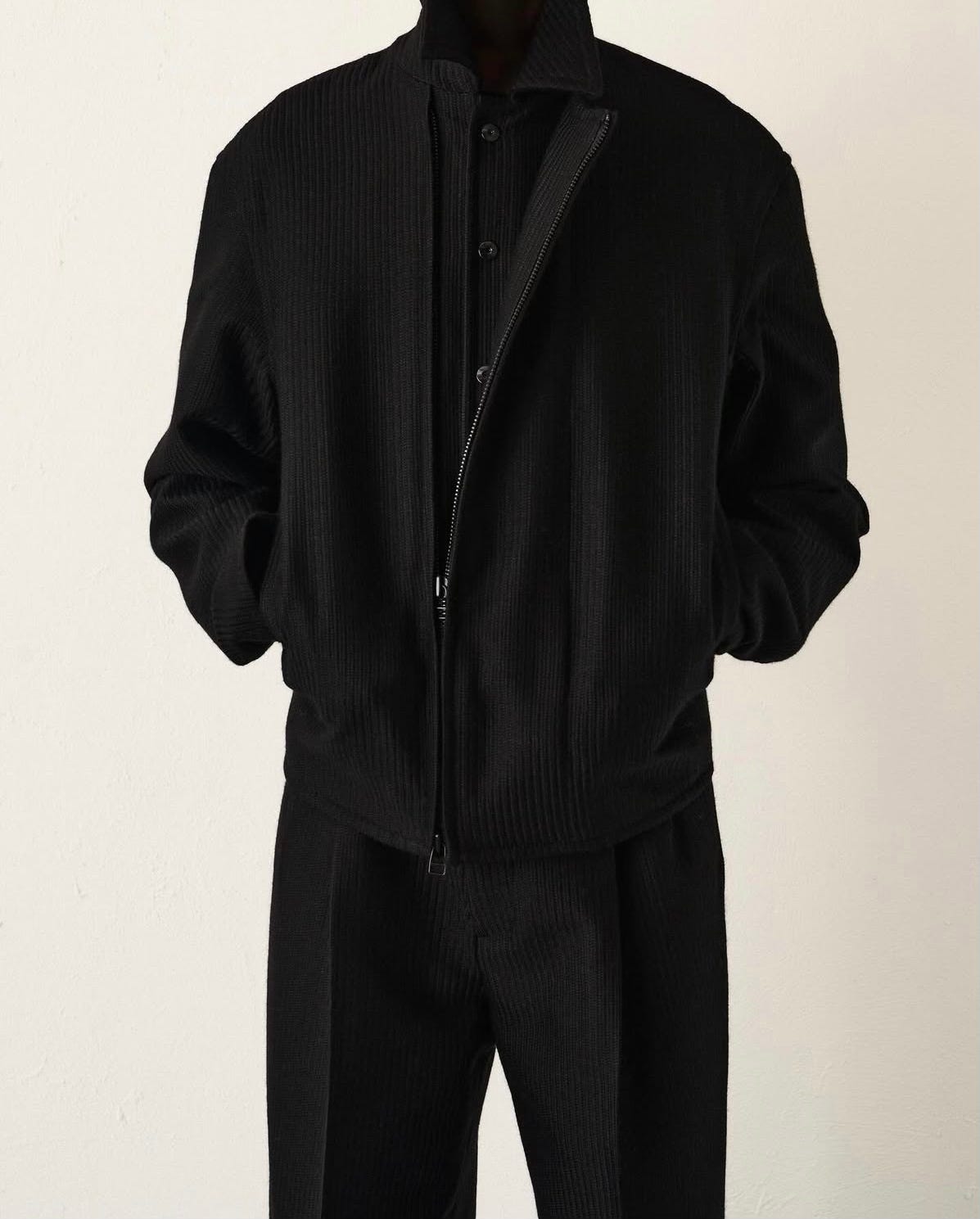


Material choices remain elevated, as always—clean, sculptural, and tactile. But there’s a slight shift in tone here. The collection feels more speculative than nostalgic. It reminded me, in an abstract way, of the Frutiger Aero aesthetic—those late-90s visualizations of soft, rounded technology and ambient interfaces. A vision of the future that now feels strangely retro. That’s the tension this collection occupies: moving forward, but not too far. Just far enough to reframe the present.
There’s something comforting about how Omar Afridi navigates this space. The pieces remain wearable but they alter perception.


Recent Projects
One of the brand’s most visible recent moves was its Tokyo store opening, a subtle but meaningful marker of its growing presence in Japan. Rather than positioning the store as a flagship in the typical sense, it feels more like a local node—an extension of the brand’s internal world made tangible. That presence, especially in the context of Japan’s retail culture, reads less as expansion and more as commitment.


Around the same time, the brand also collaborated with Vuja Dé, the Tokyo-based label by Ken Ijima—whom, I’ve been following since his early YouTube days. He’s partly responsible for my first pair of Homme Plissé trousers (and I’m sure I’m not the only one). If things go well, I might even get the chance to write something more in-depth about Vuja Dé. The brand, known for its off-center aesthetic and deep attention to form, shares a quiet conceptual kinship with Omar Afridi. The collaboration itself was low-key, with minimal documentation, but for those paying attention, the overlap was obvious. There was no aesthetic clash to resolve—just a shared understanding of how garments can hold both memory and momentum.


These projects aren’t about hype cycles. They’re signals. The kind that indicate where a brand is headed—not through press releases or capsule drops, but through carefully chosen environments and shared reference points.
Looking Ahead
Omar Afridi may be based in London, but the brand’s rhythm is unmistakably transnational. There’s Tokyo, of course—where much of the conceptual development happens—and London, where operations and production are anchored. But its market presence is starting to shift beyond those two poles.
Japan has become an increasingly natural home for the brand. Not just because of its retail footprint, but because the aesthetic logic resonates: subtle construction, material fidelity, and design that rewards attention without demanding it. The newly opened Tokyo store reflects that alignment—not as an overt statement of scale, but as a quiet extension of the brand’s spatial language. It’s clothing designed with Japanese precision, British tailoring logic, and a broader, almost placeless sensibility.
At the same time, London remains the ideological launch pad. It’s where the brand first took shape, and where its tensions—between utility and abstraction, familiarity and experimentation—are most legible. You can sense the Afghan lineage of Omar Afridi himself in the way the brand holds contradiction gently: rooted but not static, conceptual but never detached. As Hayate told me: doing things in Japan would be easy. Living in Japan would be easy. But it wouldn’t be inspiring. The inspiration comes from being connected to multiple cultures—and from staying outside the comfort zone.
As the brand grows, it’s clear that scale is not the point. The team isn’t chasing rapid expansion. Their ambition feels longer in horizon—more architectural than seasonal. What they’re building is less a label and more a system: a way of designing, communicating, and showing up in the market that holds together across cities, collections, and time.
And maybe that’s what makes it so compelling to watch. I genuinely want to see them succeed—and to get the attention they deserve.
Thank you again, Hayate and Alexander. It was a real pleasure meeting you. <3


