
Innisfree’s Decline
How a K-Beauty Pioneer Lost Its Glow.
I was genuinely surprised when I came across Amorepacific’s latest earnings report. Innisfree—long considered a pillar of the K-beauty movement and a reliable case study in eco-branding success—wasn’t mentioned at all. Typically, when a conglomerate omits a flagship name, it’s not an oversight; it’s a signal. That’s when you know something’s off.
After translating sections of the 2024 audit report, I found a video summarizing the damage: Innisfree posted a 17% decline in sales and a staggering 84% drop in operating profit. A dip in sales could be attributed to market fluctuations. But this? This points to something deeper—a brand that’s not just struggling, but structurally out of sync with its audience.
The signs are increasingly visible on the ground. In Olive Young—Korea’s undisputed barometer of beauty trends—Innisfree is steadily outpaced by newer, ingredient-led labels like Anua and Skin1004, or even other Amorepacific brands like Laneige and COSRX. It’s the clearest signal yet of a product-market misfit: Innisfree’s once-broad appeal now feels mismatched with a consumer base prioritizing minimalism, clinical trust, and fast-cycle relevance.
From Eco Darling to Cultural Holdover
Founded in 2000, Innisfree was ahead of its time. It championed natural ingredients long before “clean beauty” became industry shorthand. The brand’s identity—anchored in Jeju Island lore, volcanic ash, and green tea fields—blended ecology with romanticism. At its peak, this narrative felt fresh and pure, particularly during the height of Hallyu’s soft power expansion across Asia.
But the ecosystem shifted. Gen Z—less enchanted by floral motifs, more persuaded by ingredient efficacy—now looks to brands like Anua, Torriden, and Skin1004. These younger players reject lush storytelling in favor of minimalist SKUs, clinical language, and dermatological trust signals. Cica, niacinamide, and hyaluronic acid have replaced camellia and tangerine peel as the heroes of skincare. Innisfree, by contrast, remains anchored to an aesthetic and functional past.
Even the visual cues feel dated. While indie K-beauty now leans into monochrome packaging and gender-neutral design, Innisfree clung to nature-coded greens and floral prints until recently. A 2023 pivot toward apothecary minimalism came too late—and without the product innovation to back it up.
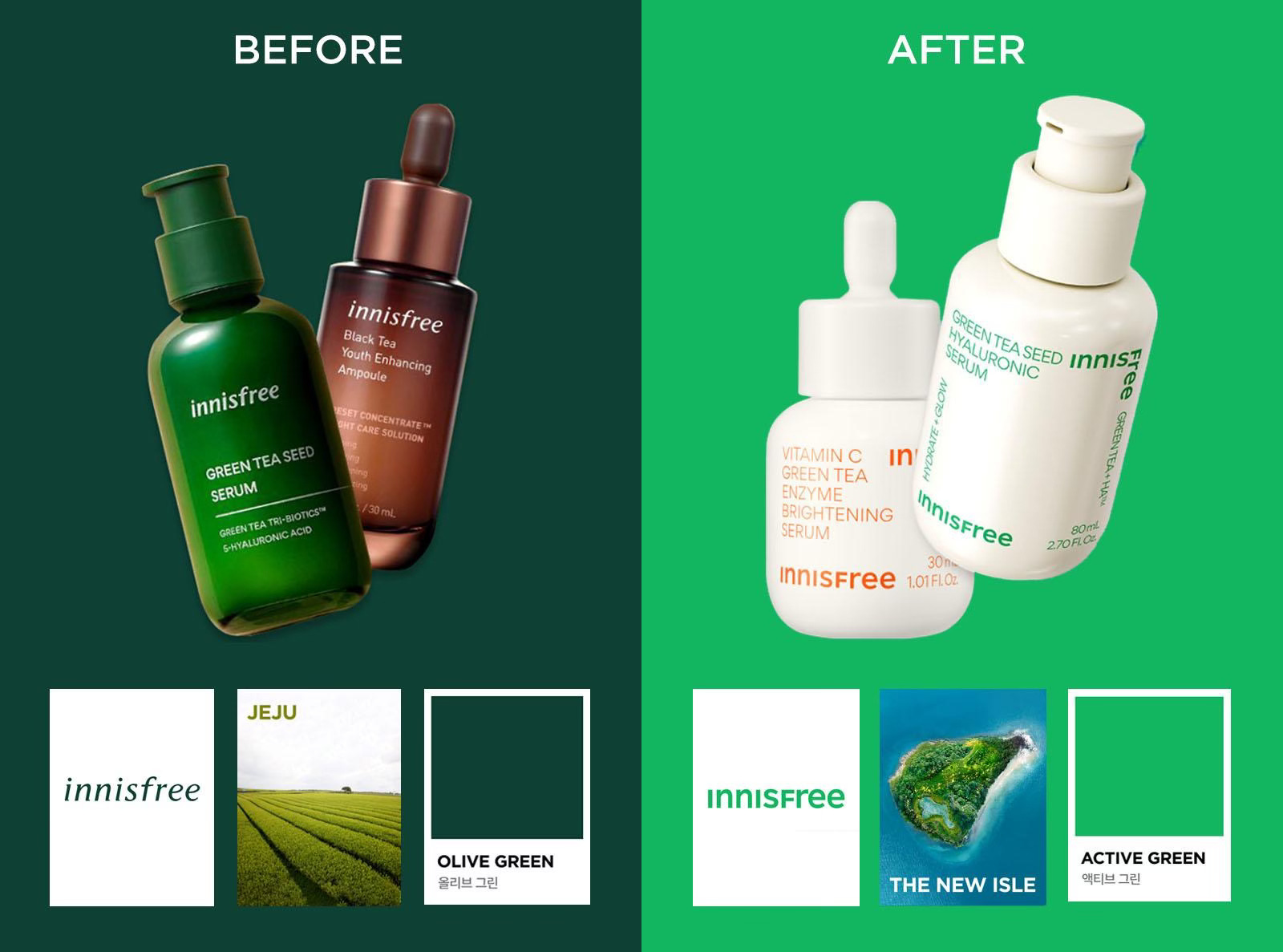
The Shift From "Natural" to "Clinical" — and the Geography of Relevance
Underlying Innisfree’s branding woes is a broader shift in consumer psychology. A decade ago, “natural” was shorthand for trust. Today, that trust is built on transparency, clinical validation, and social proof. Consumers are no longer captivated by storybook nature. They want results they can measure, routines they can track, and ingredients they can understand.
Where Innisfree once leaned on green tea and volcanic ash, newer brands compete with medical credibility: patch tests, pH balancing claims, and dermatologist endorsements. This pivot toward science-backed skincare reflects a generational evolution—but it also collides with a second axis of change: geography.
Some of Korea’s most successful skincare exports today—like Beauty of Joseon and Amorepacific-owned COSRX—derive much of their momentum from outside Korea. These brands tailor their messaging, packaging, and distribution to global expectations, often becoming better known abroad than at home. Beauty of Joseon, for instance, exports Joseon-era elegance wrapped in modern science, with the majority of its demand now coming from international consumers.


In this context, Innisfree’s hybrid strategy—rooted in pan-Asian Jeju romanticism but aiming for global relevance—feels outdated. It tried to scale using a one-size-fits-all voice. In doing so, it diluted itself: not intimate enough to feel local, not modern enough to feel premium.
This dual mismatch—between consumer psychology (natural vs. clinical) and market orientation (domestic vs. export)—is a growing fault line in K-beauty. Innisfree, once a cross-border star, now reads more like a case study in brand overstretch.


The New Blueprint for K-Beauty
Legacy K-beauty brands often assume that scale, storytelling, and retail footprint are enduring advantages. But the market has rewritten the rules—and today’s winners look less like heritage beauty houses and more like agile tech startups.
Brands like Anua and Skin1004 aren’t winning just because they’re trend-aware—they’re structurally optimized for a different game. Single-ingredient heroism. Ruthless SKU discipline. Global logistics wired for DTC immediacy. These aren’t tactics; they’re strategic commitments that legacy brands struggle to emulate without cannibalizing their own systems.


More importantly, these brands know when not to tell stories. Where legacy players default to evergreen origin myths, younger brands build trust through frictionless proof: ingredient transparency, before-and-after results, and global feedback loops. Conglomerates can deploy these tools too—Amorepacific has done so with COSRX and Illiyoon—but doing so requires a willingness to sideline legacy playbooks and accelerate development cycles.
In today’s beauty economy, agility isn’t just a startup trait—it’s a mindset. One that rewards clarity over heritage, responsiveness over ritual.
Amorepacific's Strategic Balancing Act
Innisfree’s decline can’t be separated from its parent company. Amorepacific has shown it can still deliver strong brand performance—Sulwhasoo is riding a global luxury repositioning wave, Laneige continues to thrive internationally, and Illiyoon, a personal favorite, has quietly built a cult following on the back of barrier-repair products and an ingredient-first philosophy.


This makes Innisfree’s struggle all the more conspicuous. It’s not that Amorepacific lacks innovation or global ambition—it’s that it hasn’t figured out how to make Innisfree matter again. The mass-tier, where Innisfree is positioned, now faces the double bind of intense competition and unclear identity.
Unlike indie startups that run on compressed product cycles and thrive on trend responsiveness, legacy brands within conglomerates often contend with slower development timelines and institutional hesitancy. The challenge isn’t capability—it’s clarity. With Innisfree, the signals remain mixed: aesthetic updates without product breakthroughs, campaigns without community.
For a company that knows how to win, Innisfree’s ongoing drift raises a sharper question: why hasn’t this brand been able to recalibrate? It reminds me, actually, of Vichy in L’Oréal’s portfolio—but that’s a different analysis.
Why Innisfree Still Matters
This isn’t just a corporate post-mortem. Innisfree’s stumble offers a broader cautionary tale for legacy K-beauty brands—particularly those that scaled too fast and lost their product-market fit. It’s also a warning to conglomerates still betting on nostalgia over responsiveness.
K-beauty isn’t fading. It’s fragmenting. And in that fragmentation, new power centers are emerging—decentralized, nimble, and deeply attuned to regional nuance. The next era of Korean beauty will be less about Jeju and more about judgment: who can adapt, localize, and iterate fastest?
Whether Innisfree can pivot remains an open question. But in today’s market, the challenge isn’t just reinvention. It’s relevance.